
Walk any commercial or industrial lot in October and you’ll usually find the same thing: a network of thin, dark cracks running across the drive lanes and loading areas, easy to overlook because none of them look serious yet. That’s exactly the problem. None of them look serious yet, but every one of them is an open door for the water that’s about to start freezing.
Crack sealing is one of the least expensive maintenance tasks a property owner can schedule, and it is also one of the most consistently skipped, usually because the damage it prevents hasn’t happened yet. By the time it has happened, the project is no longer a maintenance task. It’s a repair.
Why Cracks Matter More in the Weeks Before Winter Than Any Other Time of Year
Asphalt cracks year round, but the consequences of an open crack depend almost entirely on what happens to the water sitting inside it. During the warmer months, water that gets into a crack mostly evaporates or drains before it can do much damage. Once temperatures start dropping consistently below freezing, that water no longer has anywhere to go. It freezes in place, and ice takes up more space than liquid water does.
That expansion happens inside the crack, against the surrounding asphalt, with nowhere to release the pressure except outward. The crack widens. When the ice melts, the crack doesn’t shrink back to where it started. It stays wider, ready to take in even more water the next time it rains or snow melts. Repeat that cycle across a winter with multiple freeze and thaw swings, which is typical for New Jersey and Eastern Pennsylvania, and a crack that started as a hairline can become a real structural problem before spring.
Sealing a crack before the first hard freeze interrupts this cycle before it starts. Sealing the same crack in March, after it has already been through a winter, is addressing damage that has already happened rather than preventing it.
What Crack Sealing Actually Does That a Crack Filler Doesn’t
These two terms get used interchangeably, but they describe different processes with different expectations for how long the fix lasts.
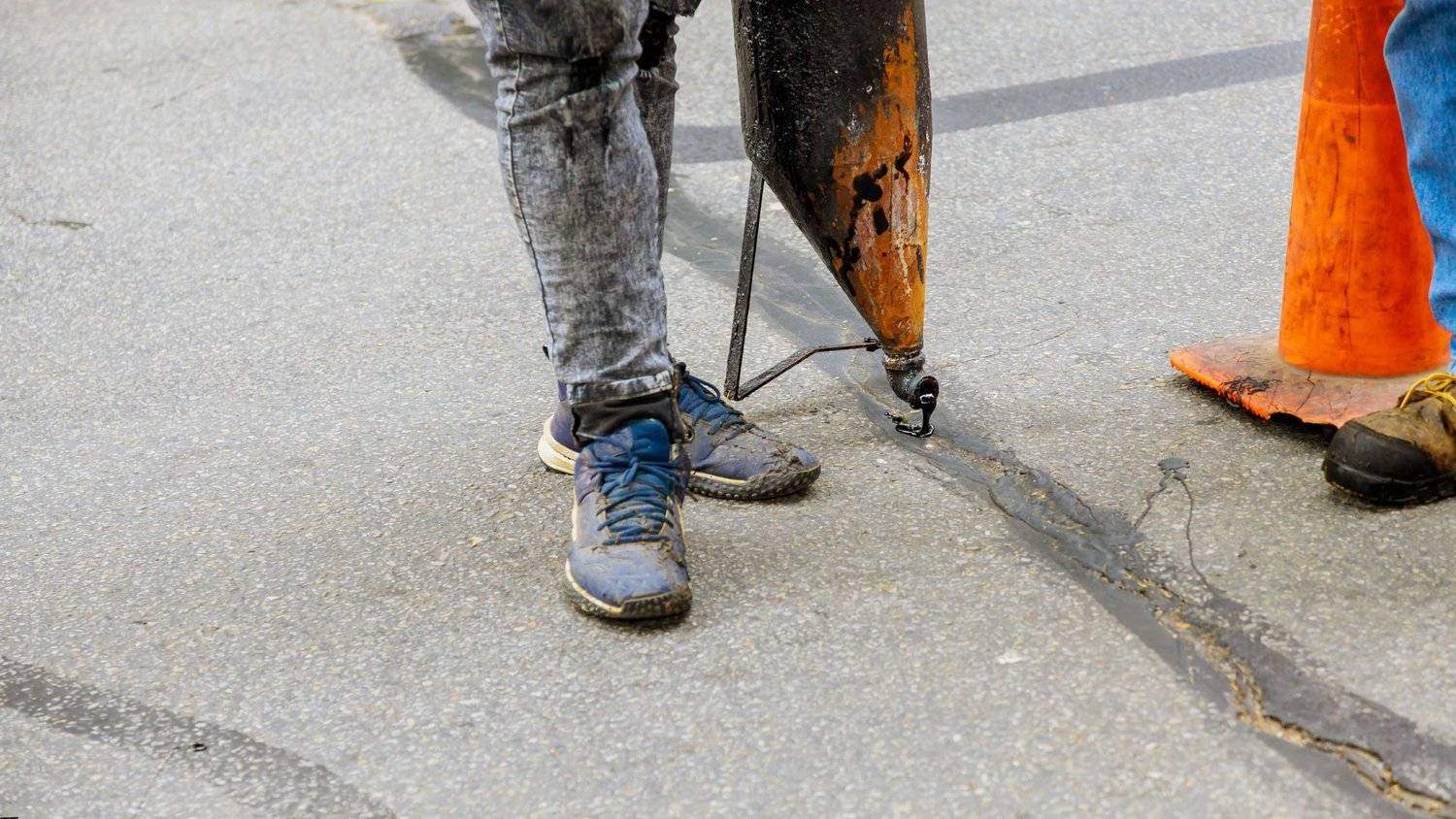
Crack filling typically uses a cold-pour or lower-grade material designed as a temporary, budget-friendly patch. It has its place, particularly on cracks that are stable and not expected to move much. Crack sealing, on the other hand, uses a hot-applied rubberized material that is designed to flex with the pavement as temperatures change throughout the year. Asphalt expands slightly in summer heat and contracts in winter cold, and a crack sealant needs to move with that cycle rather than staying rigid and cracking again at the seam.
Before the material goes down, the crack itself typically needs to be routed or cleaned out so the sealant can properly bond to the sides rather than just sitting on top of debris and old asphalt dust. Skipping that preparation step is one of the most common reasons a crack sealing job fails early, since the sealant has nothing solid to adhere to.
Why Commercial and Industrial Lots Are Especially Exposed
A residential driveway has a fraction of the surface area, and typically a fraction of the daily stress, that a commercial or industrial property deals with. That difference in scale changes how crack damage develops and how much is at stake when it’s ignored.
Commercial and industrial properties tend to have more of the conditions that create cracking in the first place. Expansion joints and control joints, which are intentional gaps designed to let large paved areas move without cracking randomly, need sealing just as much as accidental cracks do, since an open joint lets water in exactly the same way. Loading dock areas and drive lanes see repeated heavy point loads from delivery trucks and forklifts, which stresses the pavement around any existing crack and accelerates how quickly it spreads. Larger lots also mean more total linear feet of cracking to track, which makes it easy for a few problem areas to go unnoticed until they’ve already widened.
There’s also a liability dimension that residential properties don’t carry in the same way. A cracked or heaving section of pavement near a building entrance, a loading dock, or a pedestrian walkway on a commercial property is a trip hazard that property managers are expected to address, not just a cosmetic issue.
What Happens to an Unsealed Crack Once the First Freeze Hits
The mechanism is straightforward, but the compounding effect over a season is what surprises a lot of property owners.
A single freeze and thaw cycle widens a crack a small amount. On its own, that’s not dramatic. The issue is that a typical New Jersey or Eastern Pennsylvania winter doesn’t freeze once and stay frozen. Temperatures swing above and below freezing repeatedly across the season, which means the same crack goes through the expansion cycle over and over, each time starting from a slightly wider point than before.
By the time spring arrives, a crack that was barely visible in October can have widened enough to catch a tire edge, hold standing water long after the rest of the lot has dried, and start pulling apart the pavement on either side of it. Left long enough, that widening crack pattern connects with neighboring cracks and starts to resemble alligator cracking, which is usually a sign that the damage has moved past the surface and into the base underneath. Once that happens, sealing no longer solves the problem. The repair options move to patching, milling, or in more serious cases, reconstruction of that section entirely.
The counterintuitive part, and something our team brings up constantly with facilities managers who are trying to prioritize a tight fall maintenance budget, is that the cracks least likely to get flagged for repair are usually the ones most worth sealing right now. A crack that’s still thin and hasn’t opened up yet is the cheapest version of that problem you will ever get to fix. Waiting until it’s wide enough to catch someone’s attention means waiting until the sealing window has already closed and a bigger repair is the only option left.
How a Facilities Manager Should Prioritize Which Cracks Get Sealed First
Not every property has the budget or the schedule to seal every crack across a large commercial or industrial site in one pass. When prioritization is necessary, a few factors typically separate the cracks that need attention first from the ones that can wait.
- Cracks located in drive lanes and loading areas that see repeated heavy vehicle traffic
- Cracks running along or through expansion and control joints, since these are already designed weak points
- Any crack near a building entrance, pedestrian walkway, or ADA-accessible route where a trip hazard carries liability
- Cracks in low-lying areas where water is already known to pool after rain
Addressing these categories first captures most of the risk even on a property where a full crack sealing pass isn’t feasible before winter.
Common Questions About Crack Sealing Timing and Process
What’s the difference between crack sealing and crack filling?
Crack sealing uses a hot-applied, flexible rubberized material designed to move with the pavement through seasonal temperature swings, while crack filling typically uses a lower-cost, more rigid material better suited to stable cracks that aren’t expected to move much. Sealing is generally the better choice for cracks exposed to freeze-thaw conditions.
How long does a crack sealing job last?
It depends on the crack’s condition, how well it was prepared before sealing, and how much traffic and temperature swing the pavement is exposed to afterward. Properly routed and sealed cracks generally hold up well across multiple seasons, though ongoing inspection helps catch any that need attention again.
Can crack sealing be done in cold weather?
There’s a practical lower limit. The sealant needs stable, mild temperatures to bond properly to the pavement, which is exactly why the weeks before the first hard freeze, rather than the middle of winter, are the right window for this work.
Do all cracks on a property need to be sealed, or just the larger ones?
Larger cracks are more visible, but smaller hairline cracks let water in just as effectively and are often cheaper and faster to seal before they widen. A full inspection is the best way to identify which cracks are worth prioritizing on a given property.
Will crack sealing fix a pothole that’s already formed?
No. Once a pothole has formed, the damage has already moved past the surface crack stage and into a hole that needs to be patched or repaired directly. Crack sealing is a preventive measure for cracks that haven’t progressed to that point yet.