
The buses have not started running yet, but the pavement they will run on has already been sitting through a full New Jersey or Pennsylvania summer of heat, and before that, a winter of freeze and thaw. Walk the bus loop at almost any district property in late July or early August and the same pattern shows up. Cracks that were hairline in June have widened. The drop-off lane where cars idle every morning has a rut forming right where the front tires sit. Crosswalk paint near the main entrance has faded to a shadow of itself.
None of that is unusual. What matters is that school pavement operates on a schedule nothing else does. Once the first bell rings, a district loses its window to work on parking lots, bus lanes, and drop-off loops without disrupting arrival and dismissal for months. Late summer is not just a good time to look at pavement condition. For schools, it is close to the only time.
- Why late summer is the last real window for school pavement repairs
- What nine months of student and bus traffic does to a parking lot
- The three areas on a school campus that wear out fastest
- Why bus lanes take a different kind of damage than car traffic
- Faded crosswalks and striping are a liability issue, not a cosmetic one
- Small cracks now, full reconstruction later: the freeze-thaw math
- Milling versus full reconstruction: what facilities managers should ask for
- Building a repair timeline around the school calendar
- Why schools across New Jersey and Pennsylvania choose Stanley Paving
- Get ahead of the first bell
Why Late Summer Is the Last Real Window for School Pavement Repairs
Most commercial properties can close off a section of a parking lot for a few days without much consequence. Schools cannot. Once students, buses, and parent vehicles are moving through a campus five days a week, closing a bus lane or resurfacing a drop-off loop becomes a scheduling problem involving transportation directors, principals, and sometimes the district office.
That leaves a narrow stretch, usually from the end of summer programs through the week or two before staff return, when a paving crew can actually get onto the property, work without interruption, and have the surface cured and ready before the first buses roll through. Waiting until a problem becomes obvious during the school year almost always means working around live traffic, which slows the project down and raises the risk to students and staff walking through an active job site.
What Nine Months of Student and Bus Traffic Does to a Parking Lot
A school parking lot does not fail because of one bad day. It fails because the same small area absorbs the same stress, twice a day, nine months a year.
Every morning, dozens of buses and cars follow nearly identical paths into the same lanes. Every afternoon, they do it again. That repetition concentrates wear in very specific places rather than spreading it evenly across the lot, which is part of why school pavement often looks fine in general but is failing badly in three or four predictable spots.
Add in a New Jersey or Pennsylvania winter, where water works its way into any existing crack and then freezes and expands, and those concentrated weak points widen faster than they would on a property with lighter, more varied traffic.
The Three Areas That Wear Out Fastest on a School Campus
Not every section of a school property ages at the same rate. In our experience walking these properties every year, the damage almost always shows up first in the same places.
- Bus lanes and bus loops, where the heaviest, slowest-moving vehicles turn and idle in the same tracks every day
- Drop-off and pickup loops, where cars sit stationary with engine weight concentrated on one small area for extended periods
- Staff and visitor parking lots, particularly the rows closest to the building entrance where volume is highest
Recognizing which of these three zones is deteriorating fastest on a given property helps a facilities manager prioritize a repair budget instead of trying to address the entire lot at once.
Bus Lanes Take a Different Kind of Damage Than Car Traffic
A parking lot designed with passenger vehicles in mind behaves differently once school buses become the dominant traffic. Buses are heavier, they move slower through tighter turns, and they frequently stop and idle in the exact same spot every single day.
That combination creates a different failure pattern than a typical retail parking lot. Instead of general surface wear spread across the lot, bus lanes tend to develop rutting, which is a depression that forms along the wheel path as repeated pressure compresses the asphalt underneath. Once a rut forms, it collects water, and that water works its way into the base, which accelerates the problem rather than letting it stay static.
Turning zones near the bus loop see a related issue. The twisting motion of tires as a bus pivots puts lateral stress on the surface that straight-line traffic never produces, which is why cracking often radiates outward from these turning points before it appears anywhere else on the property.
Faded Crosswalks and Striping Are a Liability Issue, Not a Cosmetic One
It is easy to file line striping under appearance and move on to bigger concerns. On a school property, that is a mistake. Crosswalks, stop bars, bus loading zones, and accessible parking markings are safety infrastructure, not decoration.
Faded striping near a school entrance during the morning rush, when dozens of children are crossing between buses and the building at once, removes a visual cue that drivers, crossing guards, and students all depend on. Line striping and pavement markings also tie directly into ADA compliance for accessible spaces and van-accessible aisles, which districts are expected to maintain.
A fresh coat of striping is often one of the more affordable pieces of a back-to-school pavement project, and it is also one of the pieces that has the most direct connection to daily student safety.
Small Cracks Now, Full Reconstruction Later: The Freeze-Thaw Math
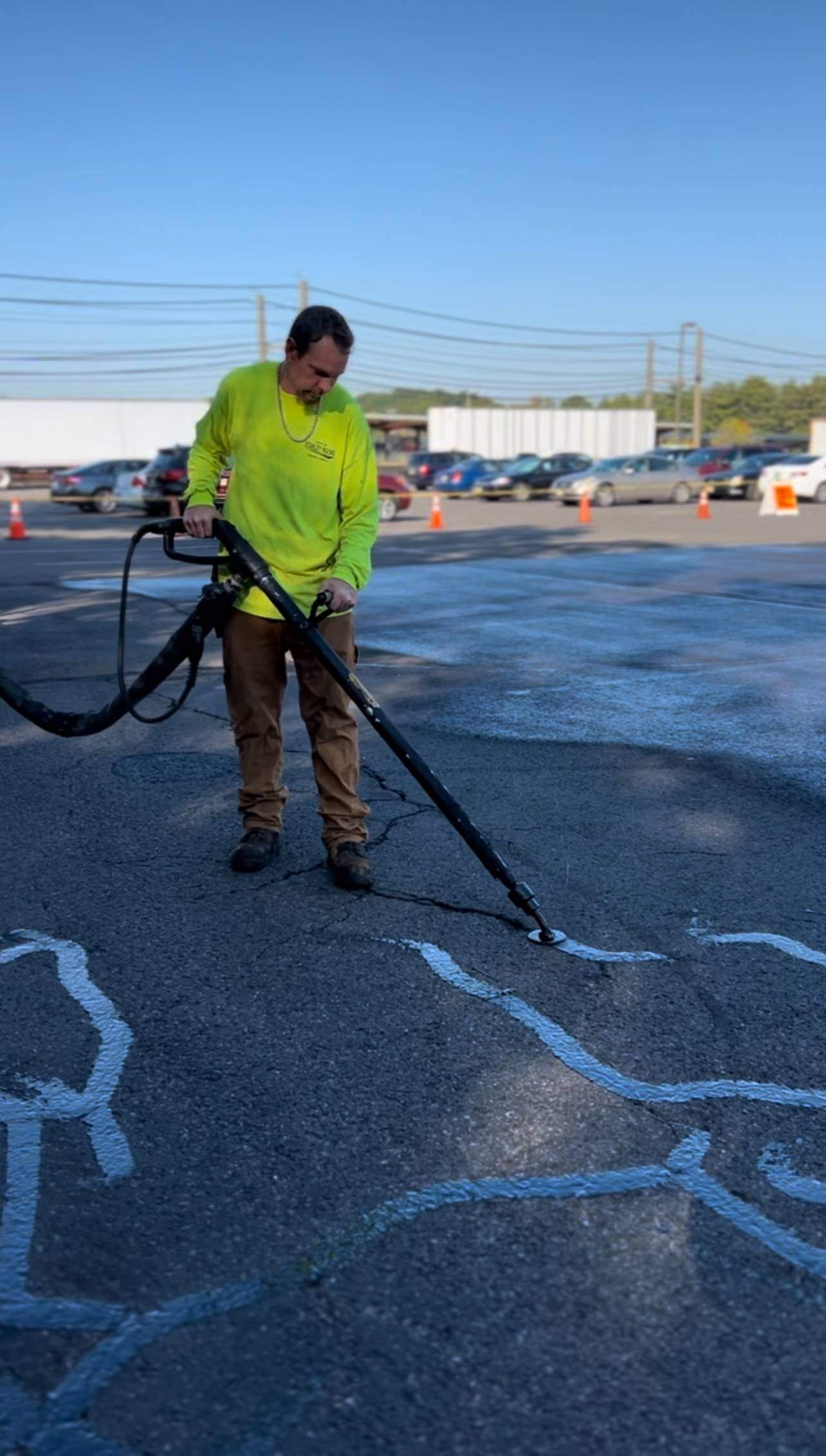
Here is the part that surprises a lot of facilities managers looking at a tight maintenance budget. The cracks that look the most minor right now, the thin ones you could almost ignore, are usually the cheapest problem you will ever have the chance to fix.
Water finds its way into any opening in the surface. Once winter arrives, that water freezes and expands, which physically pries the crack wider from the inside. The following summer, heat softens the surrounding asphalt enough that traffic pushes the crack further along its length. Repeat that cycle for a couple of winters without crack sealing, and a network of hairline cracks becomes a section of alligator cracking, which signals that the damage has moved down into the base layer rather than staying on the surface.
The counterintuitive part is this: many districts wait to address cracking until it becomes visually obvious, assuming the cost of intervention should match the visible severity of the problem. In reality, the cost of crack sealing barely moves year to year, but the cost of the repair it prevents grows substantially once the base is compromised. The best time to seal a crack is before it looks like it needs attention, not after.
Milling Versus Full Reconstruction: What Facilities Managers Should Ask For
Not every school property that looks worn actually needs full reconstruction, and this is one of the more common misunderstandings we run into on district properties. If the base beneath the asphalt is still structurally sound, asphalt milling, which removes the damaged upper layer while preserving the stable foundation underneath, can restore a lot’s surface at a fraction of the disruption of tearing the whole thing out and starting over.
The determining factor is what is happening below the surface, not just what the top layer looks like. A property with widespread surface cracking but a stable base is a strong candidate for milling and resurfacing. A property with sinking, spreading alligator cracking across large sections, on the other hand, is telling you the base itself has failed, and no amount of surface work will hold up for long over a compromised foundation.
This is exactly the kind of evaluation that should happen well before the first week of September, since determining which approach a property needs takes an on-site inspection, and the repair itself takes time to cure properly.
Building a Repair Timeline Around the School Calendar
A repair schedule that makes sense for a retail plaza does not automatically make sense for a school. Districts have their own internal deadlines, including staff development days, athletic schedules, and building access for maintenance staff preparing classrooms, all of which need to be worked around.
A workable school paving timeline typically accounts for:
- Curing time for asphalt, sealcoating, or striping before buses and vehicles resume regular traffic
- Coordination with transportation directors on which lanes or lots can be closed and for how long
- Sequencing work so that bus lanes and drop-off zones are finished before the more flexible staff parking areas
- Weather windows, since asphalt work depends on stable temperatures and dry conditions to cure properly
Districts that start this conversation in early summer generally have far more flexibility than those that wait until August, when contractor schedules across the region fill up quickly with other seasonal work.
Why Schools Across New Jersey and Pennsylvania Choose Stanley Paving
Stanley Paving has been a family owned and operated paving company since 1953, which means multiple generations of the same family have handled pavement projects across New Jersey and the greater Philadelphia area, including work for municipal and institutional clients. That kind of continuity matters on school properties, where facilities managers need a contractor who understands the scheduling constraints of an active campus, not just the paving itself.
We are fully licensed and insured in both New Jersey (HIC #13VH00622000) and Pennsylvania (HIC #036800), which allows us to serve districts on either side of the Delaware River without a gap in coverage. Our team works directly with facilities departments to plan projects around the school calendar, including:
- Parking lot paving and resurfacing for staff and visitor lots
- Bus lane and drop-off loop repair
- Sealcoating and crack sealing to extend the life of existing pavement
- Asphalt milling for properties where the base is still sound
- Line striping and pavement markings, including crosswalks and accessible spaces
As our team likes to put it after walking dozens of school lots every summer, the properties that age the best are never the ones that got the most work done. They are the ones where somebody caught the small problems early and stayed ahead of the calendar.